


The screen went blank just after a stake was deducted. On reconnecting, the balance is lower, but you cannot find the spin result. The account balance tells you how much is available at that moment. To explain the difference, you need to match the debit with the record for that round and check whether its payout, refund or final status has arrived. An unfinished animation and an unfinished account entry can be different things.
Work from the round record
Find the round or game transaction identifier in the account history. Copy the game name, timestamp and time zone, currency, stake and the balance just before the interruption if you have it. Keep the entry for the debit and any related credit. A slot history and a wallet history can show the same settlement twice, once as a game result and once as a balance movement. Those views are useful for matching records. Adding their credit amounts together could count one payout twice.
If the interface lacks an identifier, save the time window and amounts and use the operator's support route to identify the round. Two equal stakes close together may be distinct rounds, so the timestamp and amount alone are weak keys for merging them. With an identifier, you can tie a deduction to its matching settlement even if the credit appears in a later part of the history.
Reconcile three rounds on a simple ledger
Start with 100 units of cash balance. The first round debits 2 units and returns 0.60 on settlement. The second debits 3 units and is later voided with a 3-unit refund. The third debits 1 unit and is still pending at the first review. These are invented transactions with one wallet, one currency and no deposit, withdrawal or bonus transfer.
| Round | Debit | First credit | First status |
|---|---|---|---|
| 1 | 2.00 | 0.60 | Settled |
| 2 | 3.00 | 3.00 | Voided |
| 3 | 1.00 | … | Pending |
Adding the balance movements gives 97.60 units. The first round accounts for a settled loss of 1.40. The second accounts for a zero net change. The remaining unit is the pending debit. If you stop the calculation there, keep the pending round separate from completed losses. Its balance impact is already visible, while the final return is still unknown. That distinction lets you check both the wallet and the results of completed play from the same records.
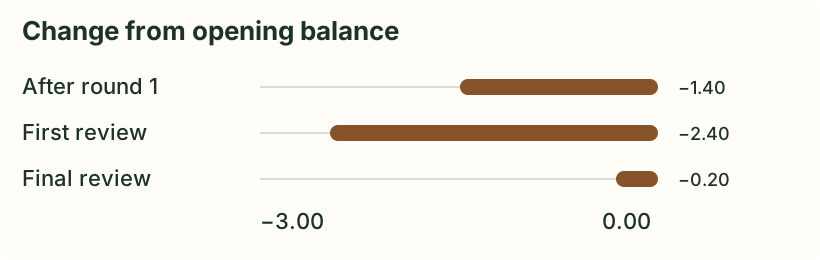
Now suppose the operator later settles the pending round and credits 2.20. The balance becomes 99.80. The final change on the three-round ledger is a loss of 0.20 units. When you compute the return on completed paid rounds, exclude the voided round under the stated reporting convention. Paid stakes total 3 units and payouts total 2.80. The gross sample ratio is about 93.33% on those two rounds. It is simply the ratio for this exercise and cannot estimate the game's theoretical return.
Read the applicable interruption rule
Check the written policy for the particular game and operator. The UK Gambling Commission's RTS 10 is a useful example of why the stage of interruption matters. Its guidance for gaming distinguishes a single-stage event interrupted before an outcome is generated, a result that stands after the player has no further influence under the described conditions, and a multi-stage game that can be restored to its last known state. In the first case the guidance calls for the deducted stake to be returned. The guidance also describes systems keeping enough information to recover an event when applicable.
This is a reference to the UK standard and its conditions. For a particular wallet entry, use the rules that apply to the account and game. Ask support which state they recorded and which rule produced the settlement. A free-spins sequence may require more context than a single ordinary spin. Look for the paid initiating round and any linked stages. A count of animations or bonus screens does not identify the number of paid transactions.
Check whether the difference is timing or a missing transaction
Put all posted cash movements in time order, including payments outside the game if there were any. An account balance can span several games, while a game log covers a narrower set. If you compare a cash-only balance with a figure that includes bonus credits, write down which wallet each amount belongs to. Mixing currencies, timestamps or wallet types can create a difference that disappears once the scope is aligned.
Where the round history lists a payout but the wallet has no matching movement, preserve that gap as an open item. Where the wallet has a credit and the game history has a matching result, record one cash movement with both references. If the operator records a void without a matching refund, ask which transaction returned the stake and when it was posted. In a real dispute, keep the original export or screenshots and avoid adding further activity while you trace the difference. A quieter ledger makes the chronology easier to read.
Check the two ways of closing the ledger
The first review has three debits totalling six and two credits totalling 3.60. The cash difference is −2.40. At the later review, the 2.20 credit reduces that gap to −0.20. You can also check the closed account by removing the three-unit debit and its equal refund as a pair. The remaining stake debits total three and their payouts total 2.80. Both methods reach the same final change. If they disagree on a real record, check whether a refund or duplicate view was included on only one side.
Put the unresolved item into one question
State the round identifier, amount, currency and timestamp. Say which entry you see and which related entry is missing, without assuming the outcome. A question such as “Which credit or refund settles this debit?” gives support a concrete line to find. Ask for the final status and the relevant game rule. If an export later fills the missing line, save the new version and note the time of reconciliation.
The closed example balances at 99.80 because the opening 100, every debit and every matched credit are visible. The first review at 97.60 still had a pending unit. Keep both views dated if you are checking how a dispute evolved. When you cannot reproduce the balance from the records you have, write down the remaining difference and the exact interval it covers. That is a better starting point for a review than a guess based on how far the animation got.